Your garage door looks simple — but behind it is a high-tension torsion spring system doing most of the heavy work. Every open and close cycle puts hundreds of pounds of force through a single coiled spring. When that spring starts to fail, the whole system becomes unsafe, unbalanced, and at risk of sudden breakdown. The good news: springs almost always give warning signs. Here's what to look for.
Why Garage Door Springs Matter More Than You Think
Torsion springs are responsible for counterbalancing the full weight of your garage door — typically 100 to 300 lbs depending on the door size and material. Without spring tension, your opener is working against dead weight it was never designed to handle on its own.
A failing spring doesn't just make the door inconvenient. It can burn out your opener motor, snap cables, misalign your tracks, and in a worst-case scenario, cause the door to drop suddenly and without warning. Spring failure is one of the most common — and most preventable — causes of garage door emergencies across Metro Vancouver and the Fraser Valley.
6 Warning Signs Your Spring Is About to Break
Catching these early can be the difference between a planned repair and an emergency callout. Each sign below is a signal — not a coincidence.
The Door Only Lifts a Foot Off the Ground
If your garage door opens 6–12 inches and then stops, this is one of the clearest signs of spring failure. The opener may still attempt to run — but without spring tension it simply doesn't have enough mechanical advantage to lift the full door weight.
- Spring has already snapped or lost most of its tension
- Opener strains, clicks, or reverses after partial lift
- Door may feel rock-solid when you try to assist it manually
A Loud Bang from the Garage
Many homeowners describe it as a gunshot. That sound is the sudden, violent release of tension from a snapped torsion spring — and it is exactly as alarming as it sounds. If you hear it and your door stops working immediately after, assume a broken spring and do not attempt to operate the door.
- Sound is sharp and distinct — not a rattle or a squeak
- Usually occurs overnight when the spring is cold and under stored tension
- Spring coil separates into two pieces on the shaft above the door
The Door Feels Extremely Heavy
Pull your emergency release cord and try lifting the door manually. A properly balanced door should feel relatively light — around 8–10 lbs of effort for most residential doors. If it feels like you're lifting dead weight, that's exactly what it is: the spring is no longer doing its job.
- Door requires significant effort or feels immovable
- Weight feels sudden — noticeably worse than it did before
- A clear sign the torsion spring is failing or already broken
A Visible Gap in the Spring Coil
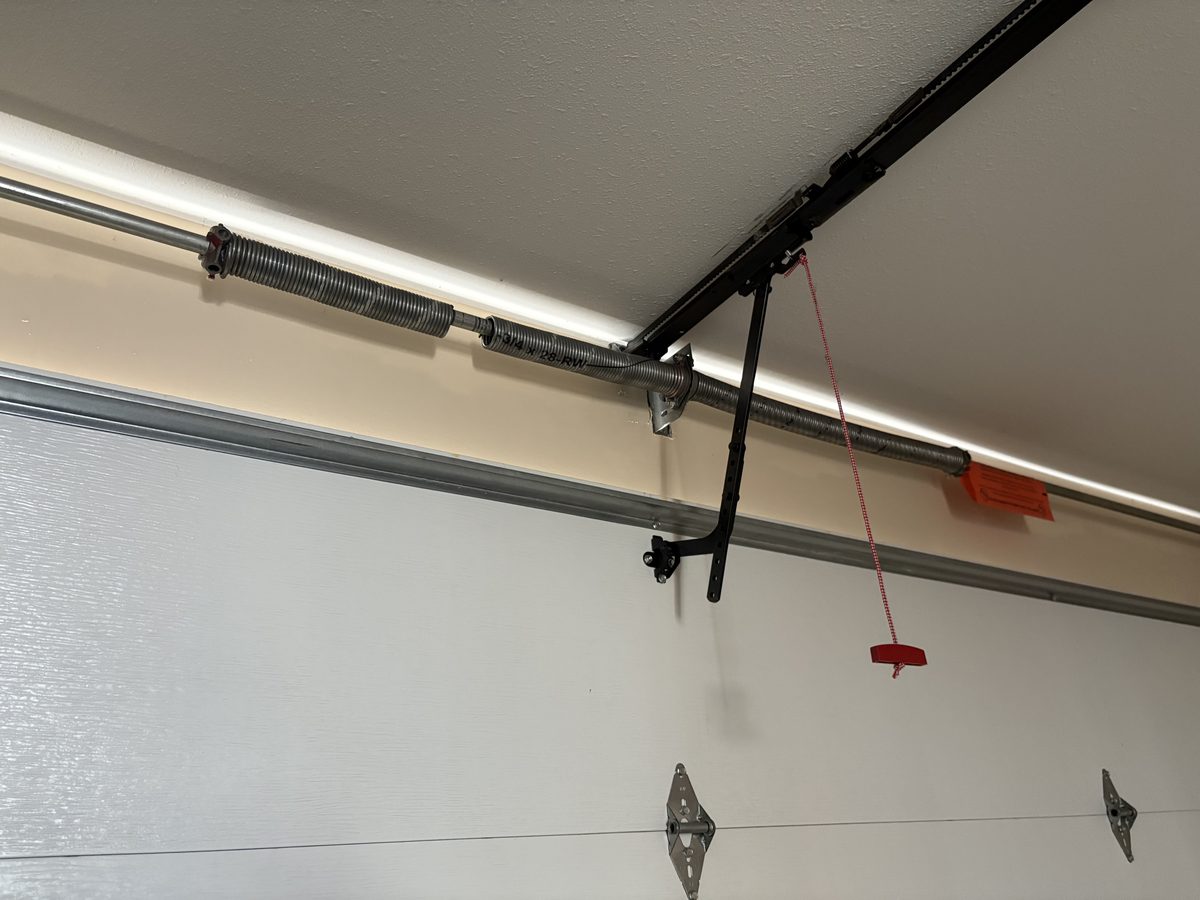
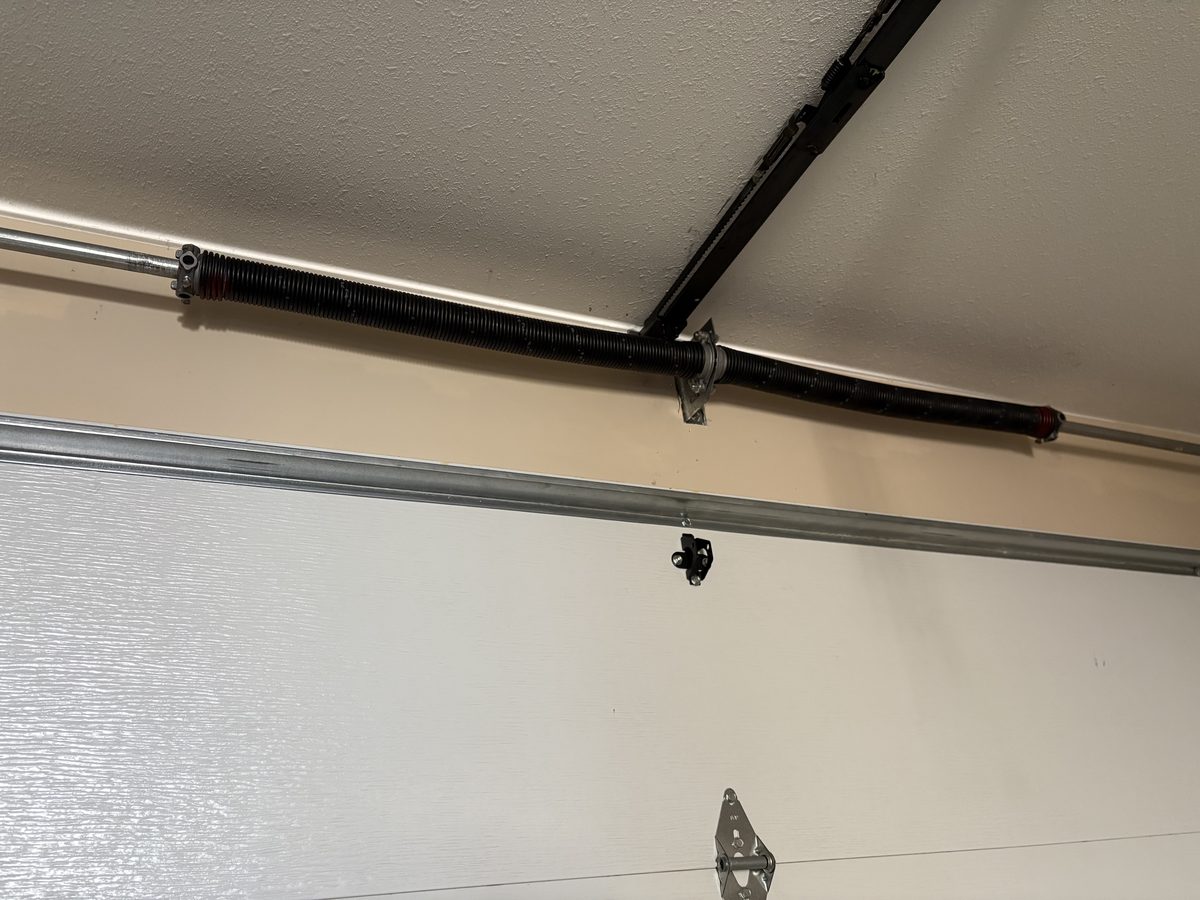
Look at the horizontal spring mounted above the door on the torsion bar. If you can see a gap of 2–3 inches in the coil where the metal has separated, the spring has snapped. This is the most definitive visual confirmation of a broken spring — there is no ambiguity.
- Gap is usually visible without tools — a clean break in the coil
- Spring may appear slightly unwound or stretched near the break
- Do not attempt to operate the door if you see this
The Door Slams Shut or Closes Too Fast
A healthy spring controls the rate at which the door descends — it applies resistance throughout the closing movement to prevent a sudden drop. A worn or failing spring loses this braking ability. If your door is closing faster than it used to, or if it drops with a thud when it reaches the ground, the spring tension is no longer adequate.
- Door drops quickly in the last 1–2 feet of travel
- Loud impact when it hits the ground
- Jerky, uneven, or stuttering movement during operation
Safety risk: A door that drops without control is a serious injury hazard — particularly for children and pets. Do not ignore this symptom.
Crooked or Uneven Door Movement
Many residential garage doors use a dual-spring system — one spring on each side of the torsion bar. When one spring weakens before the other, the door becomes unbalanced. One side lifts higher than the other, creating visible crooked movement and placing uneven stress on cables, rollers, and tracks.
- Door appears to lift higher on one side during operation
- One cable may appear slack or loose while the other is taut
- Left unchecked, this leads to cable snapping, roller derailment, or track damage
Why Springs Fail — and When to Expect It
Most residential torsion springs are rated for approximately 10,000 open/close cycles. At four uses per day, that's roughly seven years before the spring reaches its rated lifespan. But several factors accelerate failure well before that point.
Factors That Shorten Spring Life in BC
- Coastal moisture and humidity — rust forms inside the coil, weakening the metal over time
- Heavy insulated doors — place greater demand on springs with every cycle
- Lack of annual lubrication — dry springs wear faster and corrode more quickly
- Poor original installation — incorrect spring sizing shortens the effective lifespan significantly
- High-cycle properties — strata units and rental properties can exhaust springs in 3–4 years
What Happens When a Spring Snaps
When a torsion spring breaks, the door essentially becomes dead weight. The opener may still attempt to run — and this is where secondary damage occurs. Forcing an opener to lift a door without spring support can burn out the motor, strip gears, or damage the drive mechanism. Cables that relied on spring tension may also go slack, come off their drums, or snap entirely.
The door itself is now unsafe to operate. Do not use the opener. Do not try to manually force the door open. In a worst-case scenario — such as a spring snapping mid-travel — the door can drop onto a vehicle, object, or person below.
Spring Showing Any of These Signs?
Dörguard technicians carry springs for most residential door sizes. We can diagnose, replace, and balance your system in a single visit — usually within 1–2 hours.
Repair or Replace — What You Need to Know
Garage door springs cannot be repaired — they are replaced. Once a spring has snapped or reached the end of its cycle life, the coil metal is fatigued and cannot reliably hold tension again. The only correct fix is a full replacement.
Best Practice: Replace Both Springs Together
On a dual-spring system, if one spring breaks it's almost certain the other is at or near the same point in its lifespan. Replacing only the broken spring leaves you with a mismatched pair — one new, one worn — which causes uneven operation and a second breakdown in the near future. Replacing both at once costs only marginally more and significantly extends the service interval.
After new springs are fitted, a proper installation includes full system balancing: testing the door at the midpoint to confirm it holds position, inspecting cables and drums, checking rollers and hinges, and confirming opener force settings are calibrated to the new spring tension.
Can You Replace Garage Door Springs Yourself?
The direct answer is no — not safely. Torsion springs store an enormous amount of mechanical energy. A standard residential torsion spring holds between 150 and 300 ft-lbs of torque when wound. An improper winding tool slip, an incorrect spring size, or a misread of the winding direction can result in the spring releasing that energy instantly — causing severe injury or worse.
This is one of the few home maintenance tasks where professional service is the unambiguous recommendation. The tools required are specialized, the physics are unforgiving, and the margin for error is essentially zero.
Preventive Maintenance — How to Extend Spring Life
The single most effective thing you can do to extend spring life is annual lubrication with a dedicated garage door spring lubricant (not WD-40, which removes protective coatings). Beyond that, an annual tune-up catches early-stage wear before it becomes a failure.
- Annual inspection and tune-up — catch wear before it becomes failure
- Lubricate springs and moving parts — reduces friction and corrosion, especially in coastal BC
- Replace worn rollers — worn nylon rollers place additional strain on the spring with every cycle
- Balance testing — a balanced door puts significantly less stress on the spring system
- Strata and high-cycle properties — consider scheduling maintenance every 12–18 months
For homeowners in Langley, Abbotsford, Mission, and the broader Fraser Valley, seasonal temperature swings and coastal humidity make annual maintenance particularly worthwhile. Cold metal is more brittle; damp coils corrode from the inside out. A one-hour tune-up is considerably less expensive than an emergency spring replacement.